
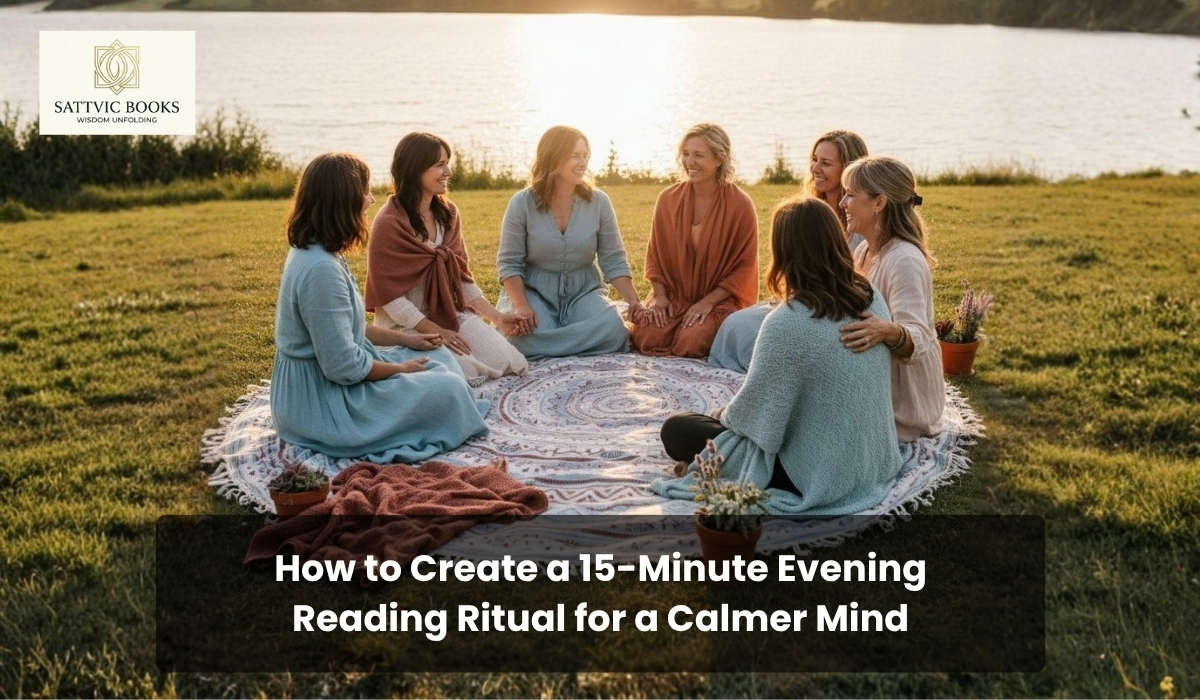
How to Create a 15-Minute Evening Reading Ritual for a Calmer Mind
Build a simple, screen-light evening reading routine that helps you step out of mental noise, reconnect with yourself, and end the day with more calm and intention.
If your evenings disappear into scrolling, unfinished to-do lists, household responsibilities, and the feeling that you never truly stopped moving, you are not alone.
Many of us reach the end of the day physically tired but mentally overstimulated. We may want rest, yet instinctively reach for the phone. We may crave quiet, yet fill every available moment with messages, videos, news, or one more thing to handle.
A 15-minute evening reading ritual offers a different kind of ending.
It is not about forcing yourself to read more books, creating the “perfect” nighttime routine, or adding another productivity task to your list. It is a small, repeatable way to transition from the demands of the day into a calmer, more intentional state of mind.
One meaningful chapter, a warm drink, low light, and a few uninterrupted minutes can become a signal to your body and mind:
The day is slowing down.
I do not need to solve everything tonight.
I can return to myself now.
Reading before bed may support relaxation and sleep as part of a consistent wind-down routine. One randomized trial found that people assigned to read a book in bed reported improved sleep quality compared with those who did not read before bed. This is not a promise that a book will fix sleep concerns, but it is a compelling reason to replace a small piece of late-night screen time with a calmer ritual.[pmc.ncbi.nlm.nih]
What is an evening reading ritual?
An evening reading ritual is a short, intentional practice of reading at the end of the day. Unlike casual reading whenever you can fit it in, a ritual has a few repeatable elements:
- A consistent time or cue
- A book chosen for the kind of feeling you want to create
- A comfortable, low-stimulation setting
- A clear beginning and ending
- A moment of reflection, rest, or release afterward
The goal is not to finish a certain number of pages. The goal is to create a small space between your busy day and your sleep.
For a Sattvic-inspired lifestyle, this practice can become a form of mental nourishment. Just as you may choose an evening meal that leaves you satisfied rather than depleted, you can choose reading that leaves your mind more settled, clear, inspired, and connected.
Why reading at night can calm the mind
The simplest benefit of reading in the evening is that it gives your attention somewhere gentler to go.
Instead of switching between messages, social media, tomorrow’s calendar, and emotionally charged content, a book asks you to stay with one voice, one idea, one story, or one reflection long enough for your nervous system to step out of constant reaction.
An evening reading habit may help because it:
- Creates a boundary between work, caregiving, household tasks, and rest
- Replaces some unintentional screen time with focused attention
- Gives the mind a quieter object of focus
- Builds a reliable signal that the day is ending
- Offers reflection, comfort, inspiration, or spiritual connection
- Helps you reconnect with your own thoughts instead of everyone else’s input
- Makes rest feel like a meaningful choice rather than an afterthought
Research and sleep-health guidance generally support reducing screen use near bedtime. A large 2025 analysis of 122,058 adults found that daily screen use before bed was associated with shorter sleep duration and a higher prevalence of poor self-reported sleep quality. The American Academy of Sleep Medicine recommends powering down handheld electronics 30 to 60 minutes before bed and suggests reading, journaling, or a warm shower as relaxing components of an evening routine.[pmc.ncbi.nlm.nih][aasm]
That does not mean you must give up your phone completely to create a reading ritual. It means you can begin by claiming just 15 minutes before sleep for something that asks less of your nervous system.
The 15-minute evening reading ritual
Your routine does not need a perfect reading nook, a large book collection, or an uninterrupted hour. It needs a beginning, a small amount of time, and one book you genuinely want to open.
Here is a simple 15-minute structure.
| Time | Step | Purpose |
| Minute 0–2 | Put away your phone and prepare your space | Create a transition out of stimulation |
| Minute 2–4 | Settle with a simple sensory cue | Tell your body that the day is slowing down |
| Minute 4–12 | Read without pressure | Give your attention one gentle focus |
| Minute 12–14 | Pause and reflect | Let the words become personally meaningful |
| Minute 14–15 | Close the ritual | Release the day and prepare for rest |
Step 1: Choose your cue
A ritual becomes easier when it is attached to something you already do.
Choose one reliable evening cue:
- After you brush your teeth
- After the children are asleep
- After you set out what you need for tomorrow
- When you make your nighttime tea
- When you plug in your phone outside the bedroom
- After you change into sleepwear
- When you turn off the main lights
Instead of relying on motivation, you are building a gentle association:
“When I do this, I read for 15 minutes.”
For example: After I brush my teeth, I make tea, put my phone on the charger, and read one chapter or five pages.
Keep the cue easy. A reading ritual that happens four nights per week is more powerful than a complicated routine you abandon after three days.
Step 2: Create a calm reading space
Your evening reading space does not need to look like a library or a luxury hotel. It needs to make reading feel easier than scrolling.
Start with a few simple details:
- A chair, side of the bed, floor cushion, or sofa corner
- A soft blanket or shawl
- A book already waiting in that spot
- A glass of water or caffeine-free tea
- A bookmark, pen, or reflection card
- Low, warm lighting
- Your phone facedown, silenced, or charging outside the room
Light matters. Light-emitting e-readers used for hours before bedtime have been shown in a controlled study to delay sleep onset, suppress melatonin, shift circadian timing later, and reduce next-morning alertness compared with reading a printed book under reflected light. If you read digitally, reduce brightness, use a warm/night display setting, avoid notifications, and consider an e-ink reader rather than a bright phone or tablet when possible.[pmc.ncbi.nlm.nih]
A printed book is often the simplest bedtime option. But if your Sattvic Books collection is digital, you can still make the experience more sleep-supportive by treating your ebook intentionally:
- Download it before your reading time so you are not opening browsers or apps
- Turn on airplane mode or Do Not Disturb
- Use the lowest comfortable brightness
- Switch to warm display settings if available
- Read on a dedicated e-reader or in a seated space earlier in the wind-down period
- Avoid turning your reading time into an invitation to check email, messages, or social media
The key is not whether your book is physical or digital. The key is whether your reading practice feels like a bridge toward calm—or another doorway into stimulation.
Step 3: Choose the right evening book
Not every good book is the right book for bedtime.
A thriller may be wonderful but too activating before sleep. A difficult business book may bring tomorrow’s to-do list back into the room. An emotionally intense memoir may be meaningful but better suited for a weekend afternoon.
For an evening reading ritual, choose a book that makes you feel steadier, softer, wiser, or more inwardly spacious.
Good books for a calming evening reading routine
- Gentle self-help books that emphasize self-compassion, reflection, or intentional habits
- Spiritual books, devotional readings, prayers, or wisdom passages
- Mindfulness, meditation, yoga, or Ayurvedic lifestyle books
- Vegetarian or plant-based cookbooks that inspire tomorrow’s nourishment
- Poetry, essays, or short reflections
- Journaling guides and guided self-reflection ebooks
- Uplifting fiction that does not create too much tension
- A reread that already feels familiar and comforting
Books to save for another time
- Work manuals, business strategy, or productivity books that trigger planning
- News-heavy books or current-events analysis
- Highly distressing nonfiction
- Fast-paced suspense, horror, or emotionally demanding stories
- Books you feel you “should” read but do not actually want to open
Your evening reading ritual should not feel like homework.
Choose the book that meets the version of you who is tired, full of thoughts, and ready to be cared for.
A helpful question: “When I close this book, how do I want to feel?”
Step 4: Read less, but read more deeply
One of the reasons people abandon a reading habit is that they set a goal designed for an idealized version of themselves.
They promise to read 30 pages a night. They choose a serious book. They start strong. Then real life happens, they miss several evenings, and the entire habit disappears.
Try a smaller definition of success:
- Five pages
- One short chapter
- One essay
- One recipe and its story
- One poem
- One page of a spiritual text
- One journal prompt
- Ten minutes, even if you do not finish the section
The point is not volume. It is return.
A Sattvic-inspired reading practice values steadiness over intensity. It asks you to build a relationship with reading that can survive busy seasons, parenting, deadlines, travel, grief, celebration, and ordinary exhaustion.
If you read only two pages one night and fall asleep, the ritual still worked. You chose a calmer ending.
Step 5: Add a one-minute reflection
The most powerful part of an evening reading ritual may happen after you close the book.
You do not need to write a full journal entry. You simply need to allow one idea to land.
Keep a small notebook, a Sattvic Books Inner Light Card, or a note page beside you. Then choose one question:
- What sentence do I want to remember?
- What did this reading remind me of?
- What am I grateful for tonight?
- What can I release until tomorrow?
- What would it look like to practice one idea from this page?
- Where did I feel peace today?
- What do I need more of in this season?
Write one sentence, not a page.
For example:
“Tonight I am releasing the belief that I need to finish everything before I am allowed to rest.”
Or:
“Tomorrow, I will make breakfast without my phone.”
A reading ritual becomes transformative when it moves from consumption to reflection. The book gives you the spark; your attention turns it into a practice.
Step 6: End with a closing phrase
Without an ending, it is easy for reading to drift into more screen use, more mental planning, or the feeling that the day is still unfinished.
Close the book deliberately. Place the bookmark. Turn off the reading light. Take one slow breath.
Then say or write a phrase that tells your mind it can stop carrying the day.
Try one of these:
- “I have done enough for today.”
- “The rest can wait until morning.”
- “I choose rest without guilt.”
- “May my mind be quiet and my body be at ease.”
- “I release what is not mine to solve tonight.”
- “I carry one good thought into sleep.”
- “Tomorrow can begin tomorrow.”
The words do not have to be spiritual to be meaningful. A closing phrase simply creates emotional completion.
A Sattvic evening reading ritual
A Sattvic lifestyle is often associated with clarity, balance, mindful nourishment, and choices that support a more harmonious inner life. Your evening reading ritual can become one of the simplest expressions of that principle.
Here is a Sattvic-inspired version of the practice:
Prepare
- Dim overhead lights.
- Set your phone away or on Do Not Disturb.
- Make warm caffeine-free tea or water.
- Choose a book that feels nourishing, calming, or spiritually grounding.
Read
- Read slowly for eight minutes.
- Do not underline everything.
- Let yourself stop at one sentence that feels meaningful.
- If your attention wanders, return gently—without criticism.
Reflect
Write one of the following:
- “Today I am grateful for…”
- “One thing I want to carry into tomorrow is…”
- “One thing I can release tonight is…”
- “This reading reminded me that…”
Rest
Close the book and place it where you can see it tomorrow.
Your reading ritual is complete. You do not need to earn your rest through more work.
A 7-night evening reading challenge
If you want to make this habit feel natural, try it for seven nights. Do not aim for perfection. Aim for repetition.
| Night | Focus | Reading ritual prompt |
| Night 1 | Begin simply | Read for five minutes and notice how you feel before and after |
| Night 2 | Make it visible | Prepare your book, bookmark, and reading space before dinner |
| Night 3 | Reduce stimulation | Put your phone away for 15 minutes before beginning |
| Night 4 | Read for nourishment | Choose a book about food, mindfulness, spirituality, or self-growth |
| Night 5 | Reflect | Write down one sentence that stays with you |
| Night 6 | Create comfort | Add tea, a blanket, soft light, or a calming scent |
| Night 7 | Review | Ask which part of the ritual made you feel most calm and keep that part |
At the end of the week, you may not have finished a book. But you will have created something more valuable: proof that you can make room for yourself at the end of the day.
Common obstacles—and gentle solutions
“I am too tired to read at night.”
Choose a short-form book: poetry, devotional readings, brief essays, a guided journal, a cookbook, or an ebook with one-page reflections. Your goal can be one page.
If you fall asleep reading, that is not failure. It may mean your body finally felt safe enough to rest.
“I only have time after everyone else is asleep.”
That may be the perfect time for a reading ritual. Keep it realistic: 10 to 15 minutes, not an hour. Protect the ritual by preparing your book and lighting earlier in the evening so you do not have to make choices when you are already tired.
“My phone is how I read.”
You do not have to abandon digital reading. Use airplane mode, Do Not Disturb, a warm screen setting, and an intentional ebook app or dedicated e-reader. If possible, read earlier in the evening and create a screen-free buffer before actual sleep.
The American Academy of Sleep Medicine recommends avoiding blue light from handheld electronics for 30 to 60 minutes before bed.[aasm]
“I cannot concentrate after a long day.”
Make the book easier, not yourself stricter. Choose a comforting reread, a short chapter, a book with visual breathing room, or one daily reflection. Read one paragraph twice if that is what your mind needs.
“I feel guilty when I rest.”
This is exactly why a reading ritual can matter.
Reading is not unproductive time. It is a way to restore your attention, imagination, and inner life. You do not need to justify 15 minutes of peace.
How to make the ritual last
The best evening routine is not the most aesthetic one. It is the one you can return to after a difficult day.
Use these principles to make your reading habit sustainable:
- Keep your current book visible.
- Choose books you genuinely want to read.
- Make the goal small enough for your busiest evening.
- Pair reading with something you already enjoy, such as tea or a soft blanket.
- Do not restart from zero after missing a night. Simply return the next evening.
- Create a small “to be read” stack so there is always a next book waiting.
- Let your reading choice change with the season of your life.
- Track the ritual only if tracking feels encouraging, not restrictive.
The practice is not about discipline for its own sake. It is about becoming someone who knows how to come home to herself.
Frequently asked questions
Reading before bed may help some people relax and create a more consistent wind-down routine. A randomized trial found improved sleep quality among people assigned to read a book in bed compared with those who did not. However, sleep varies from person to person, and persistent insomnia, daytime sleepiness, or other sleep concerns should be discussed with a qualified healthcare professional. [pmc.ncbi.nlm.nih]
A printed book is generally the simplest option for bedtime because it does not emit light. Research comparing printed books and light-emitting ebooks used before bed found that the light-emitting devices delayed sleep timing and reduced next-morning alertness in the study setting. If you prefer ebooks, lower the brightness, use warm display settings, silence notifications, and consider reading earlier in your evening routine. [pmc.ncbi.nlm.nih]
Fifteen minutes is enough to build a meaningful habit. If you only have five minutes, begin there. A brief practice you repeat is more useful than a long practice you rarely have time to do.
Choose books that match the emotional state you want to create: gentle self-help, spirituality, mindful living, poetry, reflective essays, comforting fiction, vegetarian inspiration, or a guided journal. Avoid choosing books that make you feel pressured, anxious, or more mentally activated.
That can be completely fine. Your goal is to create a gentle transition toward rest, not to meet a reading quota. Just place a bookmark in the book and continue tomorrow.
Your calmer evening begins with one page
An evening reading ritual will not remove every stressor from your life. It will not answer every question, finish every task, or create a perfectly quiet mind.
But it can offer something remarkably valuable: a daily moment in which you stop giving your attention away.
Fifteen minutes can become a small act of self-respect.
It can be the moment you choose a page over a scroll. A reflection over a reaction. A quiet ritual over one more demand. It can be a way to tell yourself, at the end of a long day:
I am still here.
My inner life still matters.
Rest is allowed.
Start your evening reading ritual
At Sattvic Books, we believe books are not only meant to be finished. They are meant to be lived with.
Choose an ebook that supports the way you want to feel at the end of the day: calmer, clearer, more nourished, more inspired, or more connected to yourself. Open one page tonight. Read slowly. Reflect gently. Let the ritual grow from there.
One book. Fifteen minutes. A calmer mind.