
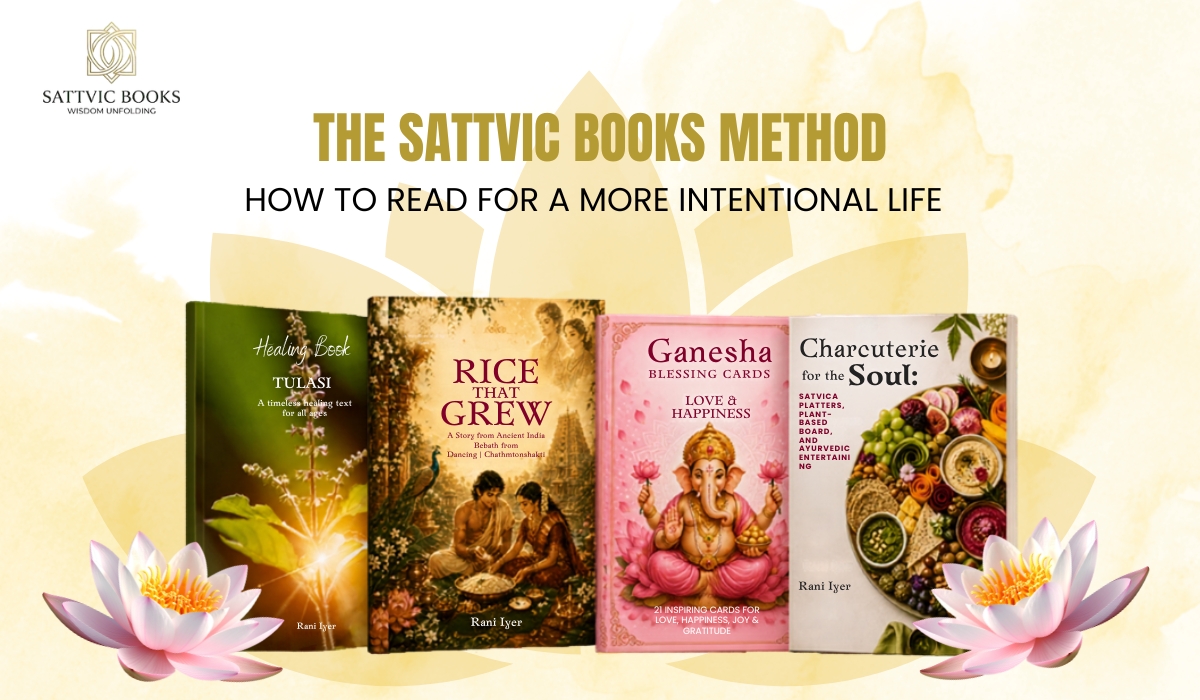
Discover a more meaningful way to read. The Sattvic Books Method helps you turn books into daily rituals for clarity, reflection, nourishment, and intentional living—one page at a time.
In a culture that constantly asks us to consume more, do more, buy more, and become more, even reading can start to feel like another thing to achieve.
We set annual reading goals. We stack books beside the bed. We save recommendations we may never open. We finish a book quickly, feel inspired for a day, and then move on before any of its wisdom has a chance to change the way we live.
But what if reading did not have to be another form of consumption?
What if a book could become a pause?
What if one chapter could become a conversation with yourself? What if one recipe could become a family ritual? What if one sentence could help you make a clearer choice tomorrow?
That is the heart of The Sattvic Books Method.
The Sattvic Books Method is a simple, intentional reading practice designed to help you read with more presence, choose books with greater care, and carry what you learn from the page into your everyday life.
It is not about reading the most books.
It is about reading the right book for the season you are in—and allowing it to nourish you.
Read slowly. Reflect deeply. Live intentionally.
What is The Sattvic Books Method?
The Sattvic Books Method is a mindful reading framework for people who want books to support a more conscious, calm, and meaningful life.
It is inspired by the principles of Sattvic living: clarity, balance, nourishment, reflection, compassion, and daily ritual.
A Sattvic reading practice asks you to become more intentional about:
- The books you choose
- The time and space you create for reading
- The mental and emotional energy you bring to a book
- The ideas you allow into your daily life
- The small actions you take after reading
- The way you return to a book when you need guidance, comfort, or perspective
This method is not about telling you what you must read. It is about helping you build a reading life that feels less hurried and more personal.
A book can be a teacher. A mirror. A source of comfort. A practical guide. A reminder of what matters. A place to meet a new idea, a new possibility, or a forgotten part of yourself.
The Sattvic Books Method helps you make space for that kind of reading.
Why intentional reading matters
Most of us are not short on content. We are short on attention.
Every day, we are surrounded by headlines, notifications, videos, messages, recommendations, podcasts, posts, and opinions. Much of it arrives without our asking. Much of it is designed to hold our attention for as long as possible.
Books ask something different of us.
A book asks us to slow down. To stay with an idea. To listen to a voice that is not trying to interrupt us every few seconds. To make room for reflection.
Reading for pleasure and personal enrichment is associated with processes that can support wellbeing, including a break from daily stressors, greater self-understanding, perspective-taking, intellectual stimulation, and connection. A 2025 realist review of 43 studies identified these as interconnected ways reading for pleasure can support wellbeing. [pubmed.ncbi.nlm.nih]
Reading can also be a meaningful alternative to constant stimulation. Recent Cambridge reporting on reading for pleasure notes associations with relaxation, wellbeing, empathy, and cognitive engagement, while emphasizing that readers benefit from choosing books they genuinely want to read. [cam.ac]
This is why intentional reading is not just about “being well-read.” It is about reclaiming your attention.
When you choose a book with care, read it without rushing, pause to reflect, and practice one small insight, reading becomes part of how you live.
The meaning of Sattvic reading
The word Sattvic comes from sattva, a Sanskrit term often associated with clarity, harmony, balance, purity, and inner steadiness.
A Sattvic approach to reading does not mean every book must be spiritual, serious, or instructional. It does not mean you should only read books that are “productive.” And it does not mean you should judge your reading choices.
Instead, Sattvic reading asks a simple question:
What kind of reading supports the life I want to live?
Some days, that may be a cookbook that helps you make a nourishing dinner.
Some days, it may be a journal that helps you name what you are feeling.
Some days, it may be a book about vegetarian living, Ayurveda, mindfulness, self-growth, spiritual practice, parenting, creativity, or home.
Some days, it may be fiction, poetry, memoir, or a familiar book that gives you rest.
Research suggests that fiction reading can support perspective-taking and empathy, particularly when readers feel transported into a story. A Sattvic reading practice makes room for this kind of reading, too. Not every book must teach a direct lesson to be meaningful. [pmc.ncbi.nlm.nih][pmc.ncbi.nlm.nih]
The question is not, “Is this book impressive?”
The question is, “How does this book meet me? And what does it help me remember?”
The five principles of The Sattvic Books Method
The Sattvic Books Method is built on five simple principles:
1. Choose with intention
2. Create a reading ritual
3. Read slowly and attentively
4. Reflect before you move on
5. Practice one idea in daily life
Together, these principles turn reading from an unfinished task into a personal practice.
1. Choose books with intention
The first step is choosing books based on your real life—not the person you think you are supposed to be.
A book can be excellent and still not be right for you right now.
You may admire a complex philosophical text but need a gentle reflection guide. You may have a long self-help book on your shelf but feel drawn to a cookbook because feeding yourself well is the most immediate form of care you need. You may think you should be reading a business book, but your mind may be asking for poetry, spiritual wisdom, or fiction.
Before you choose your next book, ask:
- What am I carrying right now?
- What do I need more of in this season: clarity, comfort, confidence, energy, nourishment, direction, or rest?
- Do I want to learn, feel inspired, be comforted, be challenged, or simply enjoy myself?
- How much mental space do I realistically have?
- What book would I be relieved to open tonight?
Choose by need, not by pressure
If you need… | Consider reading… |
More calm | Mindfulness, gentle spiritual reading, poetry, reflective essays |
More nourishment | Vegetarian cookbooks, seasonal food guides, meal-planning books |
More clarity | Guided journals, self-reflection books, practical habit guides |
More meaning | Spiritual texts, memoir, philosophy, devotional reading |
More confidence | Accessible self-help, creative practice books, skill-building guides |
More connection | Fiction, memoir, books about relationships, community, or shared experience |
More rest | Comforting fiction, short essays, familiar rereads, illustrated books |
This is not selfish reading. It is honest reading.
A book has a better chance of becoming part of your life when it meets a genuine need.
2. Create a reading ritual
A book is easier to read when it has a place in your day.
You do not need an hour of silence, a perfectly styled home library, or an elaborate morning routine. You need a repeatable cue that tells your mind: This is reading time.
A reading ritual can be as simple as:
- Reading five pages with tea before bed
- Opening an ebook while your morning coffee brews
- Reading one page of a spiritual text before checking messages
- Keeping a book in your bag for waiting rooms and school pickup
- Reading one recipe and its story before planning dinner
- Spending 10 minutes with a journal after the children are asleep
- Reading during a weekly “quiet hour” at home
The ritual matters because it reduces the need to decide. You do not have to ask yourself every night whether you will read. You simply return to the cue.
A simple 15-minute Sattvic reading ritual
Minute | Practice |
0–2 | Put your phone away, make tea or water, and settle into one comfortable place |
2–10 | Read slowly without trying to finish a chapter |
10–12 | Pause at one sentence, idea, recipe, or image that stayed with you |
12–14 | Write one line in a journal, note app, or Inner Light Card |
14–15 | Close with one question: “How might I carry this into tomorrow?” |
The power of this ritual is not in its length. It is in its repetition.
3. Read slowly and attentively
You do not have to rush through a book to prove that you are a reader.
The Sattvic Books Method invites you to let go of the pressure to finish quickly. Read one chapter twice. Pause after a paragraph. Cook one recipe more than once. Sit with a question. Revisit a page when life gives it new meaning.
Slow reading creates room for attention.
Instead of asking, “How many pages did I read?” ask:
- What did I notice?
- What made me pause?
- What felt true?
- What challenged me?
- What did I want to resist?
- What do I want to remember?
Some books are meant to be read quickly for pleasure. Others are meant to be read slowly because they ask more of you. Both are valid.
The important thing is to match your pace to the purpose of the book.
Give yourself permission to read differently
You are allowed to:
- Read only a few pages at a time
- Skip a chapter that is not relevant to you
- Re-read a favorite section
- Stop reading a book that no longer serves you
- Take notes in the margins
- Use bookmarks, tabs, journals, and reflection cards
- Read a cookbook without making every recipe
- Read an ebook on your phone, tablet, or e-reader
- Read fiction alongside self-help or spiritual books
- Return to the same book over months or years
A meaningful reading life is not a performance. It is a relationship.
4. Reflect before you move on
Reflection is the difference between reading something and letting it shape you.
You do not need to write a book report. You do not need to highlight every page. One honest question is enough.
After you read, pause for 30 seconds and ask:
- What is one idea I want to keep?
- What did this chapter make me feel?
- Where does this show up in my own life?
- What would I tell a friend about this page?
- What am I being invited to notice?
- What feels possible now that did not feel possible before?
If you are reading a recipe book, reflect differently:
- What meal would feel most nourishing this week?
- What ingredient do I want to try?
- What recipe could become a family ritual?
- How can I make this meal work for my schedule and budget?
If you are reading a spiritual or self-help book:
- What belief am I ready to soften?
- What practice am I willing to try?
- What sentence do I need to return to tomorrow?
- What would a kinder response to myself look like?
The one-line reflection practice
Keep a notebook beside your book, or use a digital note on your device. At the end of each reading session, write only one line:
“Today, this book reminded me that…”
Examples:
- “Today, this book reminded me that I do not have to rush every meaningful change.”
- “Today, this book reminded me that a simple meal can still be an act of care.”
- “Today, this book reminded me that I can rest before I have finished everything.”
- “Today, this book reminded me that I want to speak to myself with more gentleness.”
Over time, these small reflections become a record of your inner life.
5. Practice one idea in daily life
The final step of The Sattvic Books Method is practice.
A book becomes most valuable when it moves beyond information and enters your day.
This does not require a dramatic transformation. It asks only for one small, visible action.
| What you read | One Sattvic Books Method practice |
| A vegetarian cookbook | Cook one new plant-forward recipe this week |
| A book about mindfulness | Take three slow breaths before opening your phone each morning |
| A self-help book about boundaries | Practice one honest “I cannot commit to that right now” |
| A spiritual text | Carry one passage with you or read it again before sleep |
| A book about gratitude | Name one thing you are grateful for before bed |
| A home or decluttering guide | Clear one small surface and notice how it feels |
| A book about rest | Protect 15 minutes of screen-free quiet tonight |
| A parenting or relationship book | Ask one more curious question before giving advice |
The action should feel almost too small to matter.
Small is the point.
When you practice one idea consistently, you create a bridge between inspiration and change. You learn that a book is not only something to understand. It is something to live with.
How to build an intentional reading list
An intentional reading list is not a collection of every book people say you should read. It is a small, living library of books that support the person you are becoming.
Try building your reading list in categories.
Your Sattvic Bookshelf categories
| Category | What it supports | Examples of book types |
| Nourish | Food, energy, home cooking, mindful meals | Vegetarian cookbooks, seasonal cooking, food memoirs |
| Reflect | Self-awareness and emotional clarity | Journals, self-help, personal essays, reflective prompts |
| Restore | Rest, calm, and nervous-system support | Gentle wellbeing books, poetry, nature writing, comforting fiction |
| Deepen | Spiritual curiosity and inner life | Vedic texts, devotional reading, yoga philosophy, meditation |
| Connect | Empathy, belonging, and perspective | Fiction, memoir, relationship books, community stories |
| Create | Imagination, courage, and self-expression | Creativity books, artist memoirs, writing prompts |
| Live | Everyday intentionality | Home rituals, habits, family life, values-based living |
Choose one book from only one or two categories at a time. Too many open books can create the same mental clutter as too many open tabs.
A simple intentional reading stack
Try this three-book approach:
1. One practical book
A cookbook, habit guide, home guide, or self-help book you can apply right away.
2. One reflective book
A spiritual title, journal, memoir, poetry collection, or book that helps you look inward.
3. One pleasure book
Fiction, romance, mystery, essays, a reread, or anything you genuinely enjoy.
This gives you flexibility. On a tired night, you might read the pleasure book. On a quiet morning, you might open the reflective one. On a Sunday afternoon, you might cook from the practical book.
A full reading life contains all three: learning, reflection, and joy.
How to read more without turning reading into pressure
If you want to read more books, begin by making reading easier—not by making the goal bigger.
Keep the book visible
A book in a drawer is easy to forget. Place your current read where your habits already happen:
- On your nightstand
- Beside your coffee maker
- In your bag
- On the sofa
- Next to the children’s bedtime books
- On your desk for a midday pause
Visibility is a quiet form of encouragement.
Read in small pockets of time
You do not need a free hour.
Try reading:
- Five minutes before sleep
- Ten minutes after lunch
- While waiting in the car
- During a commute, if you are not driving
- Before a meeting begins
- While dinner is in the oven
- During a child’s practice or appointment
- On a weekend morning before the day becomes busy
Small pockets become pages. Pages become chapters. Chapters become a reading life.
Replace one scroll with one page
You do not need to delete every app to become a more intentional reader.
Try this gentle boundary:
Before you open social media at night, read one page.
Often, one page becomes five. If it does not, you still kept a promise to yourself.
Let yourself abandon books
Many readers stop reading because they think they have failed if they do not finish every book.
You have permission to stop.
A book may be wrong for the season. It may be too dense, too repetitive, too activating, or simply not for you. Thank it, place it aside, and choose another.
Intentional reading is not about forcing yourself through books you dislike. It is about being honest enough to choose what helps you return to reading.
Reading as a daily ritual of self-trust
The more you practice intentional reading, the more you learn to trust your own attention.
You begin to notice:
- Which books calm you
- Which books make you curious
- Which authors make you feel understood
- Which subjects you return to
- Which practices become part of your daily life
- Which books you want to share with the people you love
This is why reading can be deeply personal. A book may arrive when you need language for something you have not yet been able to name.
Reading for pleasure has been associated with positivity, self-understanding, empathic relationships, and connectedness; the experience is influenced not only by the book itself, but also by the reader’s environment, motivation, and ability to engage with it. [pubmed.ncbi.nlm.nih]
[arc-nenc.nihr.ac]
The Sattvic Books Method honors that reality. You do not have to read the same books as everyone else. You do not have to take someone else’s path.
You simply need to stay in conversation with your own life.
A seven-day Sattvic reading reset
If you want to begin today, try this gentle seven-day reset.
Day | Focus | Practice |
Day 1 | Choose | Pick one book based on what you need most right now |
Day 2 | Prepare | Create a simple reading space with a book, drink, and bookmark |
Day 3 | Begin | Read for five minutes without checking your phone |
Day 4 | Notice | Write down one sentence that stays with you |
Day 5 | Practice | Turn one idea from the book into one small action |
Day 6 | Share | Tell someone about a passage, recipe, or idea you loved |
Day 7 | Return | Re-read one meaningful page and choose your next reading ritual |
At the end of the week, do not measure success by pages completed.
Ask instead:
- Did reading feel more available to me?
- Did I create even one moment of quiet?
- Did one idea help me make a different choice?
- What part of this practice do I want to keep?
Frequently asked questions
Intentional reading means choosing books with purpose and reading them with attention. Instead of reading only to finish books or keep up with recommendations, you choose books that meet a real need, create a regular reading ritual, reflect on what you read, and practice useful ideas in daily life.
Start with one book that matches your current season of life. Read for five to 15 minutes at a consistent time, keep a notebook nearby, and write down one idea after each reading session. Focus on a small, repeatable ritual instead of a large reading goal.
Books about mindfulness, vegetarian living, spiritual reflection, Ayurveda, self-growth, creativity, home rituals, relationships, and personal values can all support intentional living. Fiction, memoir, poetry, and comforting rereads can be equally meaningful when they help you rest, connect, or see life differently.
Start with one book that matches your current season of life. Read for five to 15 minutes at a consistent time, keep a notebook nearby, and write down one idea after each reading session. Focus on a small, repeatable ritual instead of a large reading goal.
Start with one book that matches your current season of life. Read for five to 15 minutes at a consistent time, keep a notebook nearby, and write down one idea after each reading session. Focus on a small, repeatable ritual instead of a large reading goal.
Yes. Ebooks can be especially useful because they are portable, instantly accessible, searchable, and easy to carry through a busy day. To make digital reading more intentional, turn off notifications, download the book in advance, create a consistent reading cue, use a bookmark or note feature, and keep your phone from becoming a doorway back to social media.
Begin your Sattvic reading practice
At Sattvic Books, we believe a meaningful book can become part of the way you live.
It can inspire a meal. Start a conversation. Offer comfort during a transition. Help you build a daily ritual. Give you a question to carry into the week. Remind you to slow down. Help you return to the person you are beneath the noise.
You do not need to finish more books.
You need one book that meets you where you are.
Choose your next read. Create 15 minutes of quiet. Keep one sentence. Practice one small idea.
Read slowly. Reflect deeply. Live intentionally.